Compass Point: Resilience
Operational Resilience for Cyber Disruption
Prepare the organization to keep operating, recover faster, and make clear decisions under pressure.
Resilience connects cybersecurity planning with business continuity, incident response, vendor dependency, and executive decision making.
Schedule an Executive Consultation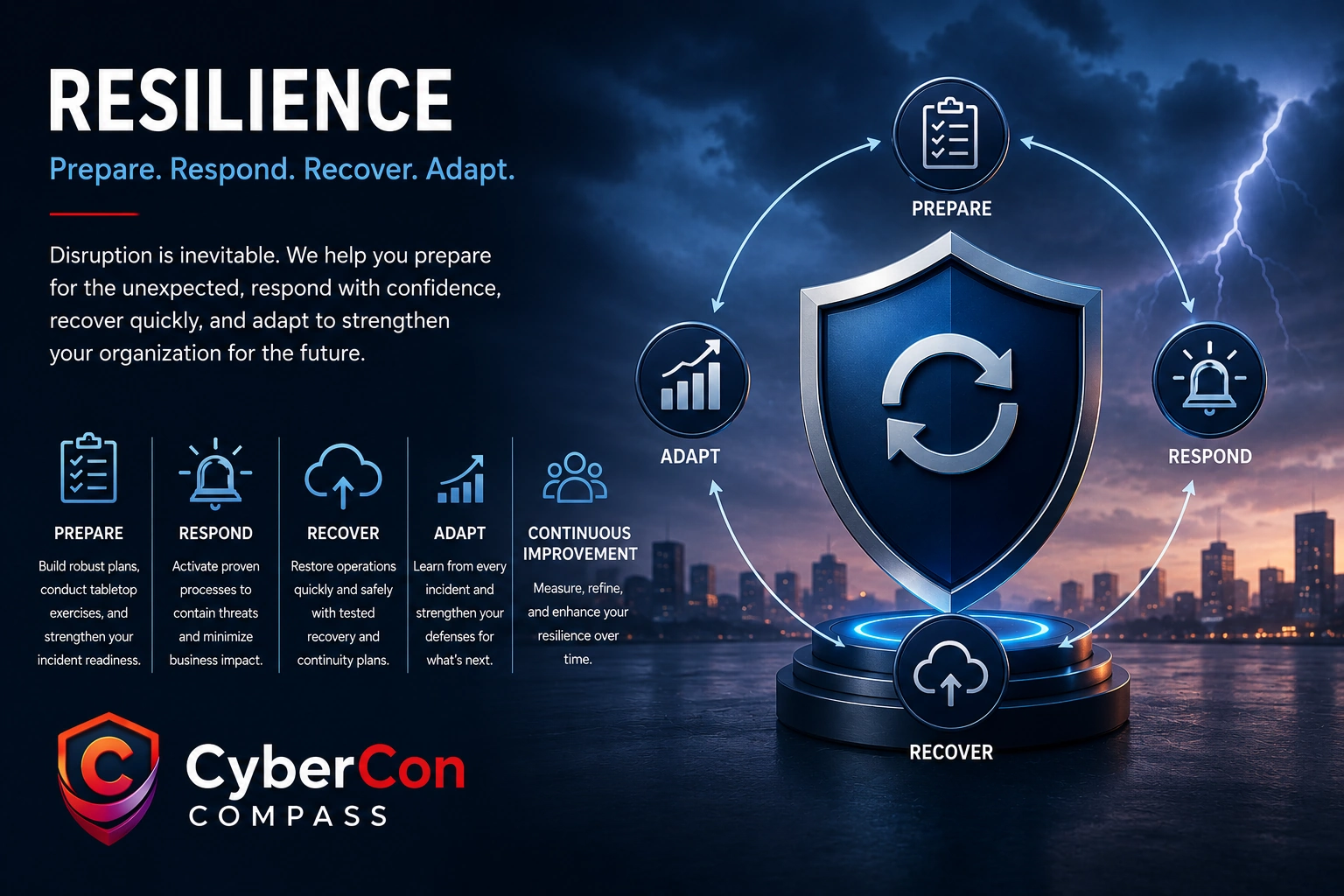
Why It Matters
Resilience Protects the Ability to Operate
Operational resilience matters because the real test of cybersecurity is not whether an organization can avoid every disruption. No organization can. The test is whether leaders understand what could interrupt operations, how decisions will be made, what capabilities must be restored first, and how the business will communicate with employees, customers, partners, and stakeholders.
Cyber incidents create business pressure quickly. Systems may be unavailable. Staff may not know which process to follow. Vendors may need to be contacted. Insurance, legal, compliance, and communications decisions may need executive input. If planning has not happened before the event, leadership loses time during the event. That delay can increase downtime, financial loss, customer impact, and reputational damage.
Resilience is broader than incident response. It includes business continuity, recovery priorities, backup assumptions, third-party dependencies, crisis communication, tabletop exercises, and executive roles. It also requires honest conversations about what the organization can tolerate. Which services must be restored first? How long can key functions be down? Who has authority to make high-pressure decisions? What outside support will be needed?
CyberCon approaches resilience as a leadership and operations issue. The goal is to help organizations prepare before they are forced to improvise. Practical resilience planning gives executives confidence that the organization can respond with structure, protect critical operations, and learn from disruptions. It also helps teams identify gaps in recovery capability before those gaps become expensive surprises.
Back to The CyberCon CompassExecutive Challenges
Executives are unsure what their role would be during an incident.
Business continuity and cybersecurity planning are separate.
We depend on vendors but have not planned for their failure.
CyberCon Approach
Practical Guidance from Assessment Through Improvement
CyberCon reviews critical operations, recovery expectations, incident response readiness, communication needs, vendor dependencies, and leadership roles. Gaps are prioritized by operational impact. CyberCon then helps develop a practical roadmap, tabletop guidance, recovery planning, and continuous improvement practices that strengthen readiness without overwhelming the organization.
- Assess current practices and business priorities.
- Prioritize gaps by operational, financial, and leadership impact.
- Build a roadmap the organization can actually execute.
- Guide implementation without unnecessary complexity.
- Review progress and improve the program over time.
Executive Outcomes
Improved incident readiness
Clear recovery priorities
Reduced operational disruption
Better executive decision making
Stronger continuity planning
Related Compass Points
Every Compass Point Works Together
Governance
Learn how cybersecurity governance creates executive accountability, decision rights, and practical oversight for business risk.
Learn More about GovernanceRisk
Learn how CyberCon helps leaders identify, prioritize, and reduce cyber risks that can affect operations, finances, and strategy.
Learn More about RiskCompliance
Learn how CyberCon helps organizations manage cybersecurity compliance readiness without last-minute audit disruption.
Learn More about ComplianceSecurity Program
Learn how CyberCon helps organizations build a sustainable security program aligned with business priorities.
Learn More about Security ProgramGrowth
Learn how CyberCon helps growing organizations mature cybersecurity in step with customers, systems, vendors, and strategy.
Learn More about GrowthReady to Discuss Resilience?
CyberCon can help leadership understand priorities, make practical decisions, and build the next step with confidence.
Schedule an Executive Consultation